One Hundred Unorthodox Strategies — #2: Plans (謀, Mou)
BigBoard Gaming · Strategy Series
___________________________________________
The Strategy
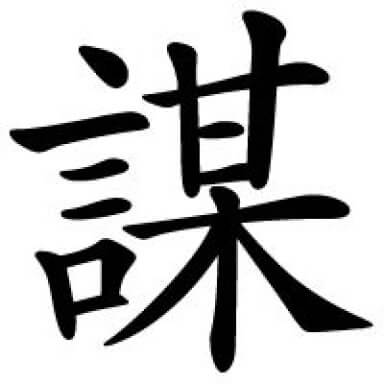
Calligraphy: Strategy 2 — Plans
Before engaging in battle, those whose calculations show many advantages will prevail; those whose calculations show few advantages will not prevail. How much more so one who makes no calculations at all. Looking at it this way, I can see who will win and who will lose.
— Sun Tzu, Art of War, Ch. 1 (Linyi Text, Huang trans.)
Strategy number 2 of the One Hundred Unorthodox Strategies is deceptively short. The core teaching is this: before committing forces, count the advantages. Not vaguely — count them. The commander who has thought through more contingencies than the enemy walks into battle already winning. The one who hasn’t thought things through is defeated before the first arrow flies or a sword is drawn. In our case it is more likely before those dice hit the table.
The tactical discussion puts it straight up, Kev style: when the enemy’s plans are elaborate, they have anticipated much — attacking their strength wastes you. When their plans are sparse, they have left gaps. Those gaps are where you strike. The whole art of pre-battle analysis is about finding which kind of enemy you’re facing.
The historical illustration draws on the Warring States period — the great laboratory of Chinese strategic thinking. Fan Sui, advising King Zhao of Qin, outlined a systematic method for evaluating rival states: how deep is their treasury? how loyal are their officers? how unified is their government? He was essentially doing what modern intel shops call an Estimate of the Situation, centuries before the term existed. Qin, the most thorough calculator of all the warring states, eventually swallowed the rest. Coincidence? The book doesn’t think so.
___________________________________________
Eastern Wisdom
Chinese art — ancient
Sun Tzu’s Chapter 1 is sometimes translated as “Laying Plans” but the Linyi text renders it more literally as Initial Estimates or Calculations — 計 (jì). The passage that connects directly to Strategy 2:
The general who wins makes many calculations in his temple before the battle is fought. The general who loses makes but few calculations beforehand. Many calculations lead to victory; few calculations to defeat — how much more, then, no calculation at all.
— Art of War, Ch. 1, p.39 (Huang, Linyi Text translation) [from memory, unverified page]
That word calculations (算, suàn) is worth sitting with. It’s not airy fairy, mystical intuition. It’s arithmetic — a structured comparison of factors. Sun Tzu lists five key factors for consideration: moral authority, weather/timing, terrain, command quality, doctrine and logistics. Run them for yourself and your enemy. Whoever scores higher wins — not always, but predictably enough to assess the risk reward of ‘taking a chance’
___________________________________________
The Western Mirror
This one maps almost surgically onto what the U.S. Army calls the Military Decision Making Process (MDMP) — specifically the Estimate of the Situation. It’s the formal doctrine for doing exactly what Strategy 2 describes: before issuing a single order, the commander and staff systematically compare their own combat power, vulnerabilities, and options against the enemy’s. The doctrinal output is a Course of Action built on that analysis rather than on gut feeling. Recently I had the opportunity to explore COA’s in the context of our actions and the enemies. While our team playing Great Campaigns of the American Civil War [GCACW] did not execute “all” the steps developing COA’s, we did use the concepts and successfully anticipated the enemies’ actions and executed a mostly successful plan. Something I now like to use even if briefly in all my wargaming. I see it as a step up and along with OODA loop analysis etc.
From my Operational Planning docs in the reference library: “The estimate process forces commanders to consider not just what they want to do, but what the enemy can do in response — and then to choose the option most likely to succeed against the broadest range of enemy reactions.” That’s Mou dressed up in NATO formatting.
The practical illustration from history: before the Inchon landing in 1950, General MacArthur’s staff produced an elaborate estimate concluding the landing was impossible. MacArthur himself acknowledged the intense skepticism of his planners, reportedly telling them, “I realize that Inchon is a 5,000-to-1 gamble, but I am used to taking such odds”.— 5,000-to-1 odds against success.
North Korea leadership believed the extreme tidal variations, narrow channels, and high seawalls made Inchon unusable for a large-scale landing, focusing their defensive efforts elsewhere, particularly on the Kunsan area. MacArthur’s counter-estimate was the opposite: because the enemy believed it was impossible, they had left it lightly defended. His plan had more factors accounted for, not fewer. Inchon succeeded. The Chinese strategic texts would have nodded along.
Where Western planning doctrine sometimes diverges from the Unorthodox Strategies is in institutional rigidity — the MDMP can calcify into process-worship, where thoroughness becomes an end in itself and the window for action closes. Strategy 2 doesn’t say “plan forever.” It says “plan more than your enemy.” Speed and depth of planning together beat depth alone.
On the table: In operational wargames like Operational Combat Series, or even simpler games such as Army of the Potomac, and The Last Gamble — spending time developing COA options, investing in recon such as we did in GCACW, placing reserves, and logistics before committing to an axis of advance or a line of defence will pay dividends. OCS in their recent releases, such as The Third Winter demonstrates how careful reserve token management for Panzer formations and Arty, along the likely Soviet routes of advance or attack in conjunction with keeping Air available for disruption, can swing the tide. The Army of the Potomac Scenarios reward a different style assessment. In AOP the dynamic movement model means setting your enemy up for destruction takes patience, and finesse in opposed play. The larger COA may be threatened by wily game play or equally significant COA assessment by your friend across the table.
The side that commits with better pre-battle setup almost always dictates the tempo. Don’t skip the planning turn.
___________________________________________
Series Note
Post #2 of 100. Next: Strategy #3 — Spies (間, Jiàn) — publishes July 2026.
Post #1 of 100. Estimates: Here
___________________________________________
BigBoard Gaming | bigboardgaming.com