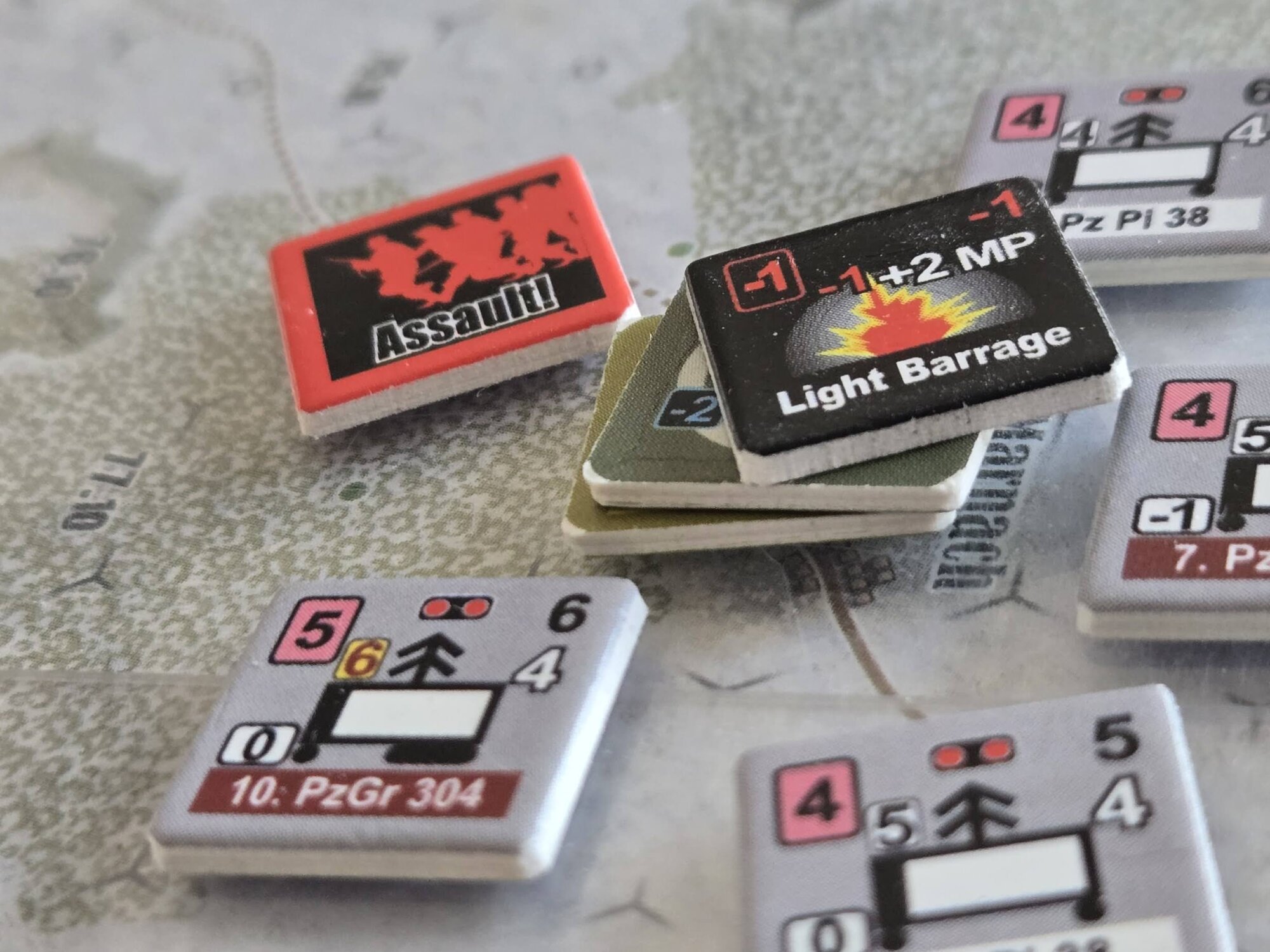
Or what AI makes of the rules from the GTS system:
Note, not my personal opinion.
In high-complexity wargaming, the greatest fiction is “perfect information.” We’ve all been there: staring at a hex map, calculating exactly when our turn will come in a predictable “I-go-you-go” cycle, and planning three steps ahead with the certainty of a chess grandmaster. The Grand Tactical Series (GTS) 2.0, however, treats that predictability as a casualty of war.
As defined in the Sequence of Play (Section 4.0), GTS utilizes a Random Chit Pull Activation System that effectively weaponizes the friction of command. Instead of a fixed turn structure, players reach into a coffee mug to draw activation chits. You might pull the same elite Formation twice in a row, or you might watch your front line crumble as your opponent draws three consecutive chits while your units sit paralyzed. This isn’t just a mechanic; it’s an overhaul of the wargaming action economy that forces you to stop solving a puzzle and start managing a crisis.
Here are five ways these mechanics redefine tactical strategy.
1. You Have to “Buy” Your Best Moments
In GTS, a seat at the table is guaranteed, but the right to fight is an expensive commodity. Every Division has a Division Activation Chit that automatically enters the mug. However, these are restrictive: under a Division Activation, units are prohibited from performing Fire actions, Assaults, or moving into an Enemy Fire Zone (EFZ). They are essentially relegated to shifting reserves in the rear or rallying.
To do the “heavy lifting”—the kinetic actions that win hexes—you must use Formation Activation Chits. Unlike Division chits, these aren’t free. You must purchase them using Dispatch Points (DPs). This creates a “pay-to-play” economy where your Dispatch Rating and Command Rating dictate the flow of orders.
“If you want the Formation Activation Chit in play this turn, it’ll cost you two Dispatch Points; if you want the Formation Activation Chit in play next turn, it’ll only cost you one Dispatch Point.”
Veteran Analyst’s Note: You cannot “spam” elite units. Per Section 7.2, you can only buy one Formation Activation Chit at a time; you must play it before you are allowed to purchase it again. This prevents the “super-stack” from dominating the mug every turn and reflects the logistical exhaustion of high-tempo operations.
2. The “Ghost” Chit That Controls the Future
While the mug is a source of chaos, Section 10.0.1 introduces a rule that allows for rare, premeditated momentum. When only one chit remains in the mug, it is not played immediately. Instead, it is set aside to become the guaranteed first action of the following turn.
This “ghost” chit represents the only moment of perfect planning in an otherwise friction-heavy system. It allows a player to set up a “double-turn” punch—finishing a turn with a strong position and knowing their best units will strike again before the opponent can react.
Strategic Pro-Tip: Keep an eye on the Direct Command Chit. This is your “wild card” that allows you to activate individual units by spending Command Points (CPs). If this ends up as the ghost chit, you start the next turn with a surgical strike capability that can plug a gap before the mug has even been filled.
3. Combat is a Test of Will, Not Just Firepower
The GTS 2.0 Combat Results Table (CRT) prioritizes organizational collapse over physical destruction. While lethal results like E (Elimination) and 1 (Step Loss) exist, they are rare. Most combat results are a psychological grind involving Troop Quality (TQ) checks.
• C (Cohesion Hit): Represents organizational fraying. A unit can take a One Cohesion or Two Cohesion marker; a third hit results in a Step Loss.
• S (Suppression): This is the ultimate “Test of Will.” When a unit takes an ‘S’ result, the defender has a choice: they can make an optional TQ Check. If they pass, the unit takes a Cohesion Hit (C) instead of being pinned. They choose to keep fighting at the cost of their long-term integrity.
• S? (Suppression Check): A “near miss” that forces a mandatory TQ Check to see if the unit maintains its nerve.
This system mirrors the reality that units rarely fight to the last man; they fight until the radio breaks, the sergeant is down, or the “will” to stay in the foxhole evaporates.
4. The Radio Operator is Your Most Vulnerable Asset
Artillery in GTS isn’t a “point-and-click” asset. To fire at range, Indirect HE units must be established in an Artillery Park and must maintain “Radio Contact” with a leader. This creates a fragile chain of command that the enemy can sever without ever firing a shot at the guns themselves.
The most punishing mechanic here is the vulnerability to Effective Fire—defined as any attack resulting in a Step Loss, a Cohesion Hit, or Suppression.
“If an artillery unit loses contact, place its Contact marker back on the unit with its Contact Pending side up.”
If the observing leader or the battery itself takes Effective Fire while In Contact, the link is instantly broken. You can silence a massive battery of 105mm howitzers simply by harrassing the crew or forcing the spotting leader to drop their headset and take cover. It turns artillery into a “high-maintenance” asset that requires constant babysitting and protection.
5. Assaulting is a “Bravery Check” Nightmare
The Human Element: No Shortcutting Bravery
In most GTS actions, you can spend CPs to “automate” success. If a unit is In Command, you can spend 1 CP to automatically pass a TQ Check (noted by the © symbol). This represents a leader’s direct intervention to keep a unit moving.
However, the Bravery Check—the TQ Check required to move into an EFZ for an Assault—is the great exception. It cannot be passed by spending a CP. Furthermore, this check is modified by the enemy’s Defense Rating. If you are charging a well-dug-in, armored position, the check becomes significantly harder. This ensures that the most harrowing moment of the game is left entirely to the quality of the men and the roll of the die. Money and logistics can buy you the bullets, but in the GTS, “money can’t buy courage.”
Conclusion: The Beauty of Friction
The rules for GTS 2.0 are intentionally “chatty” and repetitive (as noted in Section 1.1) because the system is designed to simulate a repetitive, gritty reality: war is a series of failed checks, severed radio links, and exhausting priority shifts. By forcing you to “buy” your aggression and sweat over Bravery Checks that your leaders cannot influence, the game strips away the “god-player” perspective.
In a world where you cannot even guarantee your orders will arrive on time, are you a master of the plan, or a master of the chaos?
Seems like you are coming around to it now?
Nah. An AI wrote this. Think of it as a generic commentary not my opinion.
Aha. AI wrote it. Pardon my French but we’re f%cked. Hopefully the killbot take over happens long after we’ve departed this lovely sphere.