It struck me that it might be of interest as we are as a society diving into the wolrd of AI at breakneck pace, to see how smart and dumb in the exact same breath AI can be. To see useful a tool it is and in the next breath how frustrating is its lack of common sense.
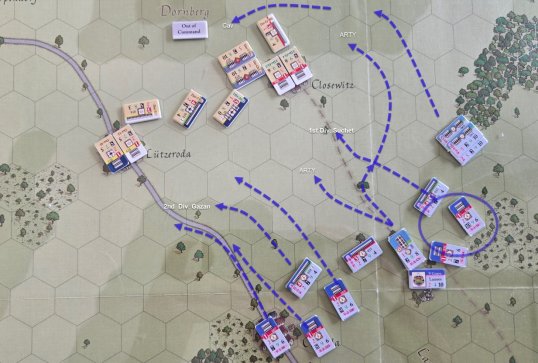
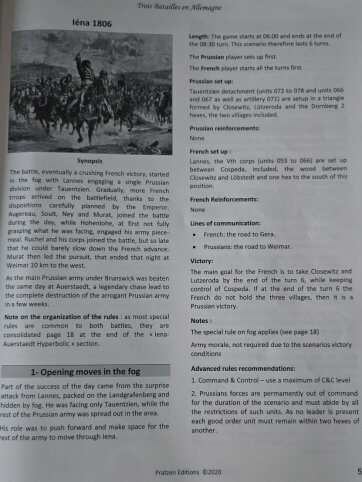
I uploaded the French starting positions for my set up for the Jena Scenario from Vive le Empreur as I had placed them. I had popped down the Prussian forces, taken a shot of that. The scenario outline, and provided a copy of the rulebook. It has my library of books catalogued to reference, and it already has built a ‘summary of the historical battle.
It jumped in and ‘read’ the rulebook –
AI: Read. Series standard rules, Didier Rouy, 3rd edition v3.3 (June 2014). What matters for your scenario:
Scale: one counter = one regiment (or two artillery batteries), one hex ≈ 250m, one turn = 30 minutes. So 0600–0830 is five turns — that’s your “handful.”
ME: Its actually 6 turns obviously in 30 minute turns…
AI: Three rule layers: Standard, Advanced, and Specific-to-this-game. Advanced beats Standard where they contradict. I only have the standard rules here; the Jena-specific set isn’t in the folder.
Command and control is optional and comes in five levels (XVII), agreed before play, each level including the ones below. Level 2 is Command Radius: units must trace 6 hexes to their corps/army/wing commander, leaders 10 hexes to their superior. Out-of-command units can’t voluntarily leave their hex except to get back in radius — but they can still change facing, change formation, fire, melee, advance after combat, and cavalry can countercharge. Your Out of Command marker means you’re playing at least Level 2.
One thing to check: the rule states plainly that “during the first turn, all units and all leaders are under command.” Your setup photo has an Out of Command marker on the board at start, so either that shot is from turn 2 onward, or the Jena-specific rules override it, or it’s scenario-imposed on Tauentzien’s detachment. Worth knowing which — if the scenario deliberately starts a Prussian formation out of command, that’s the designer making an argument about Hohenlohe’s morning.
And the finding worth flagging: there is no fog or visibility rule anywhere in the standard rules. No hits for either term across all 32 pages. The battle that every historical source describes through fog — Chandler, Fisher and Van Creveld all reach for it independently — has no weather or sighting mechanic at series level. So either the Jena-specific rules carry it, or the command-and-control levels are the abstraction standing in for it: you don’t lose sight of the enemy, you lose the ability to direct your own troops. That’s a defensible design choice and a genuinely interesting one to write about, but I can’t tell which it is until I see the specific rules.
Do you have the Jena-specific rules as a separate file? That’s where the answer is.
I’m keeping all of this for play reference only — it won’t go into the article as a source, per your standing rule that rulebooks are for the table, not for sourcing.
It then goes on to expound on the game mechanics:
Mechanically, all-Prussians-OOC for the duration means they can’t voluntarily leave their hexes — and with no commander to trace back to, there’s no way out of it. But XVII.2 still lets them change facing, change formation, fire, melee, advance after combat, and countercharge with cavalry. So they’re not passive. They’re a body that fights hard exactly where it stands and cannot be repositioned.
What that encodes is Hohenlohe’s morning as a rule rather than a choice. Chandler p. 640 has him with “no suspicion he faced the mass of the Grande Armée,” reading the noise as a flank-guard affair; Fisher p. 58 has him initially dismissing Tauentzien’s reports outright. The scenario takes that misapprehension and makes it non-negotiable — you don’t get to play a Hohenlohe who woke up. For a 5–6 turn scenario where, as you say, there’s barely room to change orders anyway, that’s an efficient way to buy the historical situation without a lot of order-writing machinery.
The honest tension: it also forecloses the one Prussian action that actually hurt the French that morning. Tauentzien historically rallied 5,000 men and counterattacked hard enough that the French “reeled back in confusion — only one squadron standing its ground,” ending up split between Krippendorf and the Isserstadt woods (Chandler p. 643). A formation that can’t voluntarily leave its hex cannot do that. So scratch that from the list I gave you earlier; it isn’t available.
Which leaves a real question for the write-up rather than a complaint: is the scenario claiming the counterattack was a local accident not worth modelling, or has it traded it away to keep the thing playable in five turns? Chandler thinks the Prussian withdrawals that morning were “unnecessary” (p. 644) — so the design and the historian are arguably making the same judgement about how much agency Tauentzien really had, from opposite directions.
The other consequence: with the Prussian side fixed and reactive, your setup convergence gets stronger, not weaker. You weren’t matching a live opponent — you were solving a given problem off the ground, and arrived where Lannes arrived.
Send the full scenario rules when you post them and I’ll check whether fog is handled there, since it isn’t at series level.
Correcting myself . There is a fog rule — I said there wasn’t based on the series standard rules, but the special rules are consolidated on page 18 of the game book, which I didn’t have. And the fog is on the turn track: turn 1 marked Thick fog, turn 6 marked Thin fog. The scenario is bounded by the weather at both ends rather than by a turn count, which is a better piece of design than I gave it credit for.
ME: Some nice self correcting, which is appreciated. I let the AI know that fog reduces movement and firepower without lots of detail and wasted ‘tokens’ explaining.
Your victory condition is harder than the history. All three villages at the end of turn 6 — take Closewitz and Lützeroda, keep Cospeda — or it’s a Prussian win. Historically Tauentzien handed over the forward villages and Napoleon got his room, which would count as a French win here; but you have to do it in six turns against a defender who can’t be manoeuvred out of position, only broken.
ME: Note it does not catch itself now talking about 6 turns instead of 5.
And the point I’d build the piece around: fog cutting movement, range and firepower is the same fog that got Lannes onto the plateau unseen. Marbot’s forty thousand packed shoulder to back, half a cannon shot away, and the Prussians “perceived nothing” (Chandler p. 642). The thing that handed you the position is the thing stopping you cashing it in.
Cutting reach rather than faking concealment is also the only honest option for a solo player — you can’t un-know the enemy’s position when you set it up yourself, so the rule takes away what you can do with the knowledge instead.
ME: With all this information in hand, I prompted the AI to suggest a better setup and a game plan for the Prussians!
“Given the ‘dire situation’ then for the Prussians. As a General face with the fog and an unknown enemy coming, and as a player…knowing Lannes is coming. What do you do? Would you change your defense positions? Would you form a Cannae style defense? Or bolster the villages? Be the general offer a plan of action for the Prussians.”
First, the hard constraint that decides everything: your plan is your setup. Once turn 1 begins you cannot voluntarily leave a hex. You can change facing, change formation, fire, melee, counter-charge and advance after combat — that is the whole of your agency. So there is no “would you change your defensive positions.” You get one decision, you make it before the French deploy, and then you live in it for six turns.
That also answers the Cannae question: no. Double envelopment needs the wings to move. You have no wings, no leader, and no manoeuvre. Anything shaped like Cannae here is just a thin line with its centre in the wrong place.
Read the victory condition, because it is not symmetrical. The French need Closewitz and Lützeroda and Cospeda at the end of turn 6. You need to deny one. Cospeda is theirs at setup and you cannot reach it. So your entire war is: hold one of the two villages for six turns. Not both. One.
Correctly ascertains the obviousness of the situation as a gamer would
Which one is not a free choice. The French set up in and around the wood between Closewitz and Löbstedt — they start on top of Closewitz and a long way from Lützeroda. Closewitz is going to fall. Lützeroda is the village they must cross open ground to reach, in fog that has cut their movement, their range and their firepower. That is where you win or lose.
So the plan:
Lützeroda is the redoubt. Put your deepest, steadiest infantry in it — the two grenadier regiments from Prittwitz’s division and one line regiment. Nothing about this garrison’s job involves winning; it involves still being there at 08:30.
Closewitz is a toll booth, not a fortress. Garrison it with the 7th Fusiliers — fire 4 and range 2, the best shooting you own — plus one line regiment. They are not expected to hold. They are there to make the French spend turns, because turns are the currency: every turn the French are reducing Closewitz is a turn they are not marching west. Fog helps you here, since it blunts the firepower they’d normally use to blow a village open quickly.
ME: It takes some prompting and a clear indication it has not really read the rules, just ‘skimmed them’. Closewitz is the challenge to get to. But lets see where this goes.
Chain, don’t scatter. With no leader, every good-order unit must stay within two hexes of another. A defence split into two island garrisons starts unravelling the moment the forward one breaks and the survivors find themselves out of cohesion. Run the line back from Closewitz across the Dornberg to Lützeroda so the chain survives the loss of the forward post.
Artillery behind Lützeroda, [For goodness sake, Arty BEHIND the village…?] not in Closewitz. It cannot displace once placed, so it must not be sited where it will be overrun in turn 2 [?]. Put it where it covers the open approach from the east, close enough that fog-shortened range still bites.
Cavalry as a tax, not a weapon. The hussars and chevau-légers are your only units with any initiative left — counter-charge, withdraw before combat, morale 10. Post them on the flank of the axis from Closewitz to Lützeroda. You are not going to charge anyone to death. You are going to make Lannes think about whether he can march past you in column, and a French column that has to move cautiously or in square is a French column arriving at Lützeroda on turn 5 instead of turn 3.
On your two lenses. The general in the fog cannot know, and his correct answer — cover the withdrawal, don’t get decisively engaged — is precisely what the scenario forbids him. The player knows Lannes is coming. But notice the sequence hands you the honest version anyway: the Prussian sets up first. You commit blind, then watch him deploy against you. That is as close to Tauentzien’s morning as a solo game can decently get.
My taunt:
is that really your plan. did you read rule 4.3. Did you look at the Fire Power of a unit in a village/town and the ‘mode ‘ it takes on. Not much of a general. 🙂
Its response:
Caught.
Two real errors, and rule IV.3 wrecks the best part of my plan.
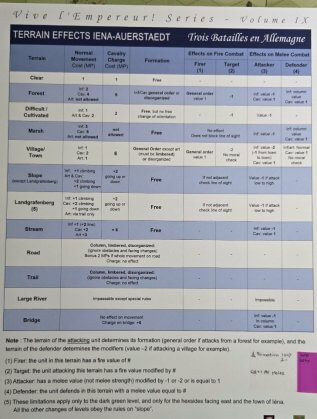
Infantry in a town is in general order, and general order sets firepower to 1. Flat. So putting the 7th Fusiliers in Closewitz because they have fire 4 and range 2 throws away the exact thing that made them worth garrisoning with. In the village they shoot like everyone else. That was the plan’s centrepiece and it was nonsense.
And artillery in a town can only be limbered or disorganized — it cannot fire at all from inside. I put the battery behind Lützeroda for the wrong reason; turns out it was the only legal way to make it useful.
But IV.3 gives with the other hand, and this is the part I should have built on: in a town, morale checks called by combat results are ignored. Not modified — ignored. A village garrison cannot be routed by fire or melee results. It can only be ground down step by step. Which means morale is irrelevant inside a village, and your worst-morale units belong there. The morale-7 line regiment that would crumble in the open is exactly as good as a grenadier once it’s behind the walls.
So the currency in a village is steps, and nothing else.
ME: Another assumption that as a human you have to ‘read between’ the lines. I do not see a TEC table with Images. But the scenario calls out ‘villages’. The assumption of no Melee morale checks is wrong and it ignores the D result also. A big miss. As the conversation progresses its recall of rules fades faster than mine!
Now the thing that makes the whole scenario click. A town garrison shoots at 1 and can’t be routed — so in clear weather the French answer is obvious: don’t assault, stand off in line at full firepower and shoot it to pieces while it replies at 1. Fog takes that away. With range and firepower cut, standing off stops paying, and Lannes has to come in and melee. And melee against general order means all six hexes are front hexes — no flank, no rear, nothing to turn. He has to grind, frontally, with a clock running.
That is what the six fog turns are for. The weather isn’t atmosphere, it’s the mechanism that forces the assault.
Revised plan:
Fill both villages with steps, not quality — the deepest units you have, worst morale first, since morale stops mattering the moment they’re inside. Lützeroda gets the larger share: it’s furthest from the French start, so it costs Lannes the most turns to reach and the most turns to grind, and turns are what you’re actually defending.
Closewitz still functions as the toll booth, but for a different reason than I gave — not because it shoots well, because it cannot be made to run away. Every turn Lannes spends prying it open frontally is a turn Lützeroda isn’t being attacked.
There is an eventual switch in thinking, that Closewitz is the key
The battery goes outside, unlimbered, covering the open approach to Lützeroda — it’s the only ranged fire you own that isn’t nullified, precisely because it can’t work from inside.
The fusiliers are the one genuine judgement call. Outside, their fire 4 works but they’re static, unsupported and will be swamped. Inside, they’re just six more steps. Given they cannot reposition once the French commit, I’d put them in the village and take the steps — but that’s a preference, not a deduction, and I’d change my mind if the terrain gives them cover adjacent to Lützeroda.
ME: I think the correct read is 4.3 should also say village. The example is a unit in a village. Village is NOT defined, nor is town.
What does hinge on it is the counter-attack fist. Under A the garrison can only be pushed out by a table result, which is relatively rare against a −2 attacker, so the 45th and 12th sitting next door are insurance against something unlikely. Under B the garrison breaks more often, and the fist stops being insurance and becomes the main mechanism.
And under B the 7th Fusiliers get interesting — fire 4 with range 2 is worth something in or beside a village if it can stay in line, where under A it’s just two steps at firepower 1.
Worth logging in the draft as a design note when you hear back. “The chart and the rulebook disagree about what a village is, and the answer changes the defender’s whole toolkit” is a concrete, checkable observation about a real game — the sort of thing that separates a reviewer that played it from one that read it.
I make some comments about how we will handle villages and it agrees [of course]
Agreed, and there’s a structural clue that supports it: the melee row says attacker −2, “−1 from town to town.” That clause only makes sense if some settlements occupy several hexes — a town you can attack across from within. Villages are single hexes. So the game does distinguish them physically while treating them as one terrain type for effects, which is exactly what the chart’s combined row says and what IV.3’s list forgot to include.
So: Reading A. Village = town for effects. General order forced, firepower 1, no flanks, no morale checks, attacker at −2.
Which breaks something in my own plan, and I should say so before you set up.
The −2 cuts both ways. My “counter-attack fist” was the 45th and 12th retaking Closewitz after a D evicted the garrison — but they’d be attacking into a village, at −2. Melee 2 becomes 0. In column, +1, so 1. Cavalry are worse: value 1 in a village and 6 MP to charge in.
There is no realistic counter-attack. The same terrain that makes Closewitz hard for Lannes to take makes it impossible for me to take back. Recovery isn’t a mechanism I have.
So the defence has to be about not losing it, and about denying him the ground he needs to attack from. Those two line regiments are worth more standing on the hexes Lannes wants to assault from than sitting behind Closewitz waiting to do something they can’t do. Every open-ground position he has to clear first is a turn he isn’t spending on the village, and turns are still the only currency I have.
The garrison itself stands: grenadiers at melee 3, defending at normal value against an attacker at 0 or 1. That’s the whole plan now — a hard hex, and everything else arranged to make him spend the morning getting into position to hit it.
ME: While a good idea setup triangle wont let him do that We go around a few more rounds. I offer a bit of coaching, and it makes assumptions and does not consider 2nd order consequences. For example its math is predicated on my guys attacking in Column. Not changing to Line, not using arty to shell first. It believes a 3:1 attack on Closewitz is impossible.
…grenadiers in Closewitz, 45th and 12th in Lützeroda — and your V Corps is up with Suchet’s five regiments centre-right facing Closewitz, Gazan’s three around Cospeda, cavalry massed on the right by the wood, horse artillery and Lannes in the centre.
On the 3:1, I make it arithmetically impossible against Closewitz, and I’d like you to check my numbers.
Melee strength is modified melee value × current steps (VIII.4). So:
Defender. Grenadiers, melee 3, in a village where the defender fights at normal value. Two regiments, five steps each. 3 × 10 = 30.
Attacker. The defender’s terrain modifies the attacker’s melee value by −2. Your line regiments are melee 2, so 2 − 2 = 0 — and VIII.3 says a unit whose modified melee value is 0 doesn’t take part in the melee at all. In column it’s +1, so 2 + 1 − 2 = 1. That’s the best value available to you: the légères are also melee 2, and there are no grenadiers in V Corps.
The scenario line reads: “Tauentzien detachment … are setup in a triangle formed by Closewitz, Lützeroda and the Dornberg 2 hexes, the two villages included.”
My forward line idea is probably illegal. Putting the 45th and 12th “on the ground he must attack Closewitz from” means the eastern and south-eastern approaches — the side Lannes comes from. That’s almost certainly outside the triangle, which looks to be bounded by Closewitz in the east, Lützeroda in the west and the Dornberg to the north. If the setup area doesn’t extend toward the French, the whole turn-buying idea dies with it.
The fallback if it does: the two line regiments go onto the hexes adjacent to Closewitz inside the triangle — its north and west faces. They stop being a blocking force and become flanking fire: any French unit that closes to assault the village from those sides takes fire from an adjacent hex, and he has to decide whether to peel off troops to deal with them. Weaker than blocking the approach, but it’s the same currency in smaller coin, and it keeps the cohesion chain intact between Closewitz and Lützeroda.
That also means the bet has to be restated more modestly. Without a forward line, the plan is simply: Closewitz is very hard to take by assault at −2 and impossible to take by fire, and six fog turns may not be enough. Turn-buying in the open was the part I was least confident in anyway, and if the setup rules don’t permit it, we find out whether the terrain alone carries the position.
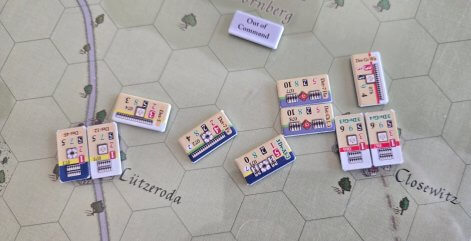
We [me and AI] settle on this defense.
I arrange my forces and my plan is to press 1st Div to Closewitz, with all of the Arty.
Arty will go to right flank, with one unit remaining to do a battery exchange in the fog with the Prussian guns. French Cav will seek to sweep and come at Pru from the rear, freeing up the infantry to move securely and close from the SE.
The 2nd Div will push up on Lutzeroda. Two turns to get into position. 1 turn of fire combat, possibly two. Then 3 turns to Melee/Assault both villages.
We have the ahistorical advantage of knowing that regardless of what is there. These Prussians are Not attacking. Which makes the second part of the CV’s moot.